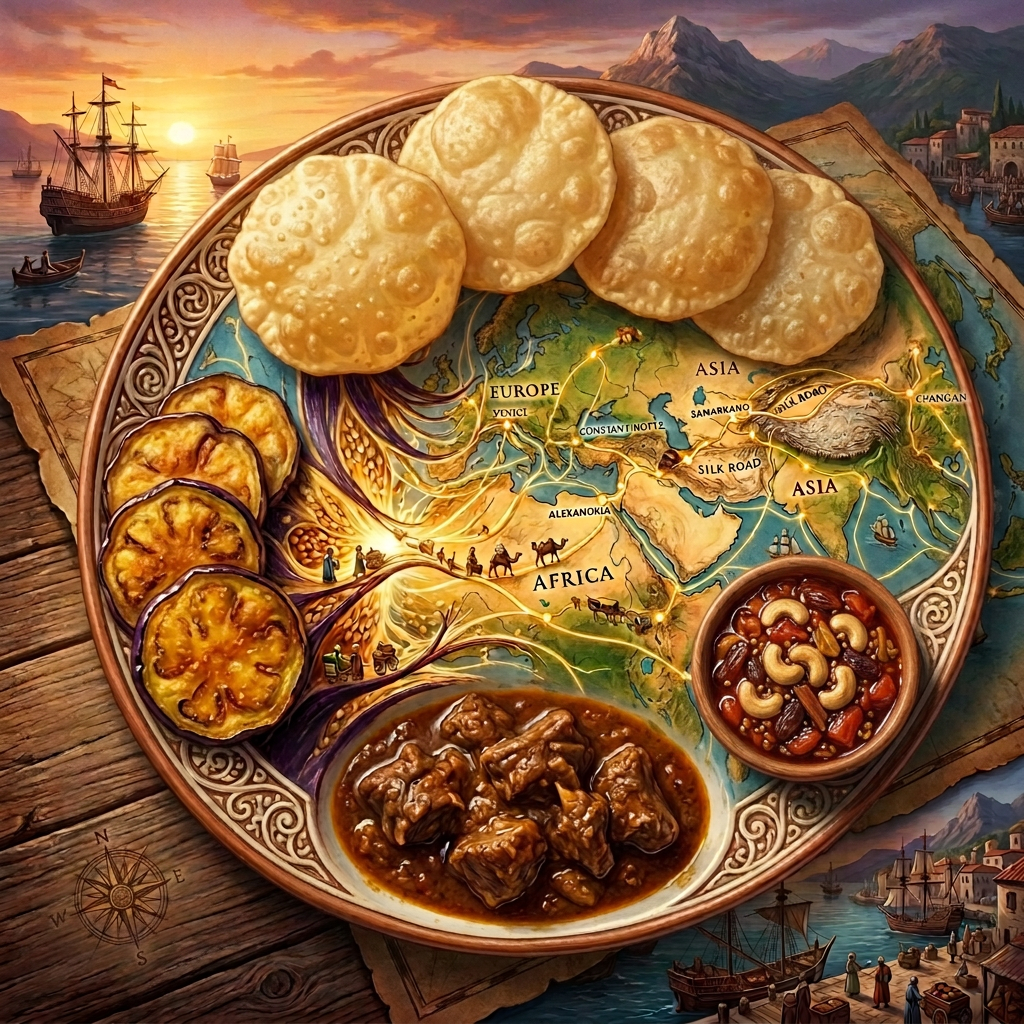
Audio 1: If you’ve ever wondered why a Friday dinner can double as a seminar on medieval trade routes, Kathakar has the answer — and it involves aubergine.
Audio 2: This episode follows a Bengali family dinner where the food itself becomes the history lesson — chutney, brinjal, and the long journeys that brought them both to the table. Let’s start with what’s on the plate.
Humble Aubergine and The Sweet Chutney Ending: Bengali Style Dining
Audio 1: The setup here is deceptively simple: two friends sit down to a home-cooked Bengali meal, and the mother at the table turns each dish into a question about where it actually came from.
Audio 2: She frames the chutney’s place in the meal before explaining its ingredients, and the line that anchors the whole conversation is this: “Food has a quiet way of preserving history. Sometimes, the newest ingredient becomes so familiar that we forget it was ever new.”
Audio 1: That’s the real stakes of the segment — the tomato in a dish that feels ancient arrived in India only in the sixteenth century, carried by the Portuguese after Columbus crossed the Atlantic. Familiar and foreign turn out to be the same thing, just separated by time.
Audio 2: And the mother is careful to explain the sequence. Before tomatoes, Bengali chutneys were made with raw mango, tamarind, wood apple, or elephant apple — always sweet or tangy, always placed at the end of the meal to refresh the palate before sweets like payesh or rosogolla. The tomato slotted in because its acidity and gentle sweetness made it a natural fit, especially once it became widely cultivated in the nineteenth and early twentieth centuries.
Audio 1: Dates had already been part of Bengal’s food culture for centuries, so pairing them with the newcomer was less invention than adoption.
Audio 2: Then the conversation turns to the brinjal, and the direction of travel reverses entirely. While tomatoes were moving eastward into India, the brinjal was already heading west — through Persia, the Arab world, and eventually into European kitchens, where it was met with suspicion because of its association with the nightshade family.
Audio 1: Treated as a garden curiosity in Europe while being happily fried every week in Bengal — that’s a gap in culinary confidence you could drive a trade route through.
Audio 2: The post traces the brinjal’s global reach: Begun-vaja in Bengal, baingan bharta in North India, imam bayıldı in Türkiye, moussaka in Greece, melanzane alla parmigiana in Italy. One vegetable, many kitchens, one long journey in the opposite direction to the tomato.
Audio 1: And the mother’s closing thought is the one that lingers: the brinjal’s greatest journey wasn’t across continents — it was into people’s kitchens. That’s where an ingredient becomes history.
Audio 2: Which is really the argument the whole post is making — that a family dinner table is where old trade routes quietly continue.
Audio 1: Empires and trade routes come and go, but the chutney waits at the end of every meal.
Audio 2: And the questions those dishes carry — where something came from, how it arrived, why it stayed — those are worth bringing back next time. Read more…

