(Recap: Vani was invited for Friday dinner at Megh’s place. Before the dinner, they have discussed on ancient and medieval India’s financing and banking architectures. Later Megh’s mother asks them to have the dinner. So, they move to the dining hall).
Megh: Mom, it smells delicious!! I just love Luchi and Begun Vaja!!
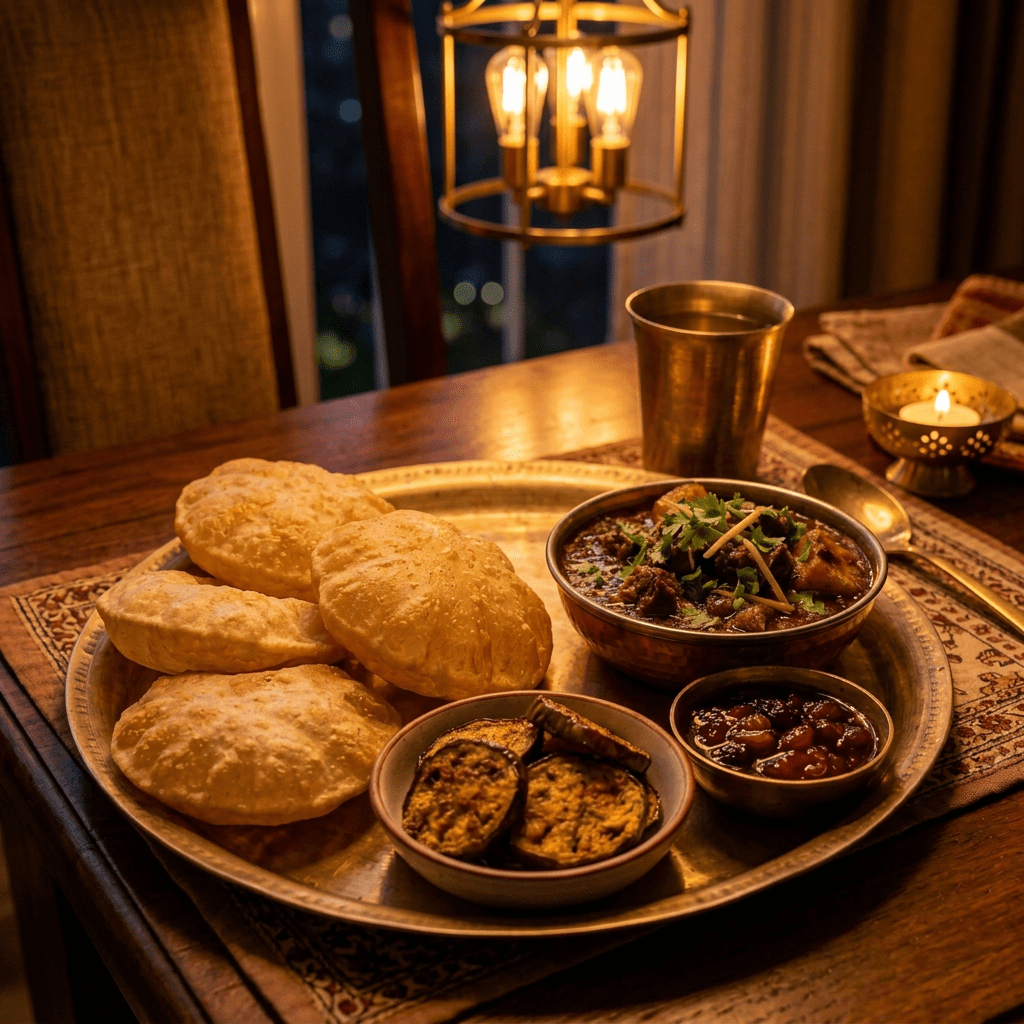
Mother: Vani, today I cook Luchi, Begun-vaja, Kosha Mangsho, and Tomato-Khejur Chutney just for you, dear!!
(Luchi is actually Bengali style soft puffed deep-fried flat-bread, Begun-vaja is deep fried aubergine, Kosha Mangsho is a slow-cooked Bengali mutton curry, and Tomato-Khejur Chutney is a sweet and mildly spiced tomato and date chutney served at the end of a meal. Together, they capture the flavours, traditions and quiet joy of a classic Bengali family dinner.)
Vani: (With excitement) Thank you, Aunty!! I just love them.
Megh: Don’t waste time in discussion let’s dive into the food now. Friday dinners never disappoint me (while smiling).
Mother: (While serving food to them) Yet you always wait until the very end to eat the chutney (with gentle smile in face).
Vani: (While enjoying the food) Aunty, why does a Bengali meal end with chutney, always!!
Mother: That’s because chutney is more than just another dish. It has a story. In fact, one of its main ingredients reached Bengal only a few centuries ago.
Megh: The tomato, right!!
Mother: Hmm!! People remember it, but rarely ask where it came from ((placing a spoonful on Both’s plate).
Vani: Aunty, then please tell us more on that we will love to learn this while enjoying the food.
Mother: Long before tomatoes arrived, Bengalis already enjoyed chutneys. They were usually made with raw mango, tamarind, wood apple, elephant apple, or other seasonal fruits. Some were sweet, while others were tangy. The purpose was the same: to end the meal with a refreshing change of flavour.
Megh: So the chutney came first. The tomato came later.
Mother: Exactly! The tomato is native to South America. It travelled across the Atlantic after the voyages of Christopher Columbus and was later brought to India by the Portuguese during the sixteenth century. At first, many people were uncertain about this unfamiliar fruit. Like many new foods, it took time to find a place in Indian kitchens.
Vani: So nobody immediately thought of making chutney from tomatoes?
Mother: Not at all! For generations, tomatoes were grown in limited quantities and were used sparingly. Only during the nineteenth and early twentieth centuries did they become widely cultivated across India.
As tomatoes became cheaper and more abundant, Bengali households began experimenting with them. Their gentle sweetness and natural acidity made them ideal for chutney.
Megh: And where does the khejur (Dates in english) come in?
Mother: Dates had been part of Bengal’s food culture for centuries. When combined with tomatoes, they added richness, while raisins balanced the flavours and spices such as roasted cumin and dried chillies completed the dish. Gradually, tomato-khejur chutney found its place at the end of festive meals, family gatherings and Sunday lunches.
Vani: So what feels timeless today is actually the result of old traditions welcoming a new ingredient.
Mother: (Gently smiling) Exactly! Food has a quiet way of preserving history. Sometimes, the newest ingredient becomes so familiar that we forget it was ever new.
Megh: There’s still one thing I don’t understand. Why do we eat chutney at the end instead of with the rest of the meal?
Mother: Because every part of a traditional Bengali meal has its own place. The meal begins gently, becomes richer with dal, vegetables, fish or meat, and finally slows down with chutney before dessert. It is a carefully arranged sequence of flavours.
Vani: So chutney is not a side dish.
Mother: No! It marks the closing chapter of the meal. Its sweet and tangy taste refreshes the palate after richer dishes and prepares it for sweets such as payesh, mishti doi or rosogolla.
Vani: (Gently smiling) That explains why no one touches the chutney until everything else is finished.
Mother: Exactly! Eating chutney with Luchi or rice at the beginning would feel rather unusual in a traditional Bengali household. Its place has always been at the end. Some traditions do not announce themselves. They quietly become part of everyday life until we forget to ask why they exist.
Megh: (reaching for another slice of fried aubergine) We’ve spent so much time talking about the chutney that I almost forgot this. I think I like the Begun-vaja even more.
Mother: (smiling) That doesn’t surprise me. A well-fried slice of begun has settled many family arguments.
Vani: And unlike the tomato, this vegetable has been part of Indian kitchens for a very long time.
Megh: Really? I assumed it came from somewhere else too.
Mother: Many people do. But the story of begun is quite different. In fact, while tomatoes were still unknown in India, the brinjal had already begun travelling in the opposite direction. Merchants carried it westwards through Persia and the Arab world. From there, it reached the Mediterranean and eventually Europe.
Vani: So Europe discovered the brinjal (i.e., aubergine) through Asia?
Mother: Exactly! For centuries, Europeans regarded it with suspicion. Some even believed it could cause illness or madness, partly because it belongs to the nightshade family, which also includes a few poisonous plants. As a result, the brinjal appeared in gardens long before it became common on dining tables.
Megh: Imagine that. A vegetable we happily fry every week was once treated with suspicion.
Mother: History has a wonderful sense of humour. The familiar often begins as the unfamiliar.
Vani: And today, almost every cuisine seems to have its own version.
Mother: Indeed. Whether it is Begun-vaja in Bengal, baingan bharta in North India, imam bayıldı in Türkiye, moussaka in Greece or melanzane alla parmigiana in Italy, the humble brinjal has found a home far beyond the land where it was first cultivated.
Megh: (Looking at the last piece of fried aubergine on his plate) So this simple vegetable has travelled farther than I ever will.
Mother: (smiling) Perhaps!! But its greatest journey was not across continents. It was into people’s kitchens. That is where every ingredient truly becomes part of history.
Vani: And perhaps that is the nicest thing about food. Empires rise and fall. Trade routes disappear. Kingdoms become history. Yet every time a family gathers around a table, those old journeys quietly continue.
Megh: (While smiling gently) I’ll never look at tomato-khejur chutney or fried begun in quite the same way again.
Mother: Good! Because the best meals do more than satisfy our hunger. They leave us with a story to remember.

