Voice 1: Kathakar runs a site where history arrives unannounced at your door on a Saturday afternoon — much like a good friend who assumes you weren’t doing anything important.
Voice 2: Today we’re following that thread: ancient trade routes, a port that connected Bengal to the world long before Kolkata existed, and what it meant for goods, monks, and ideas to move together across open water.
Voice 1: Let’s start with the port itself — and why almost nobody remembers it.
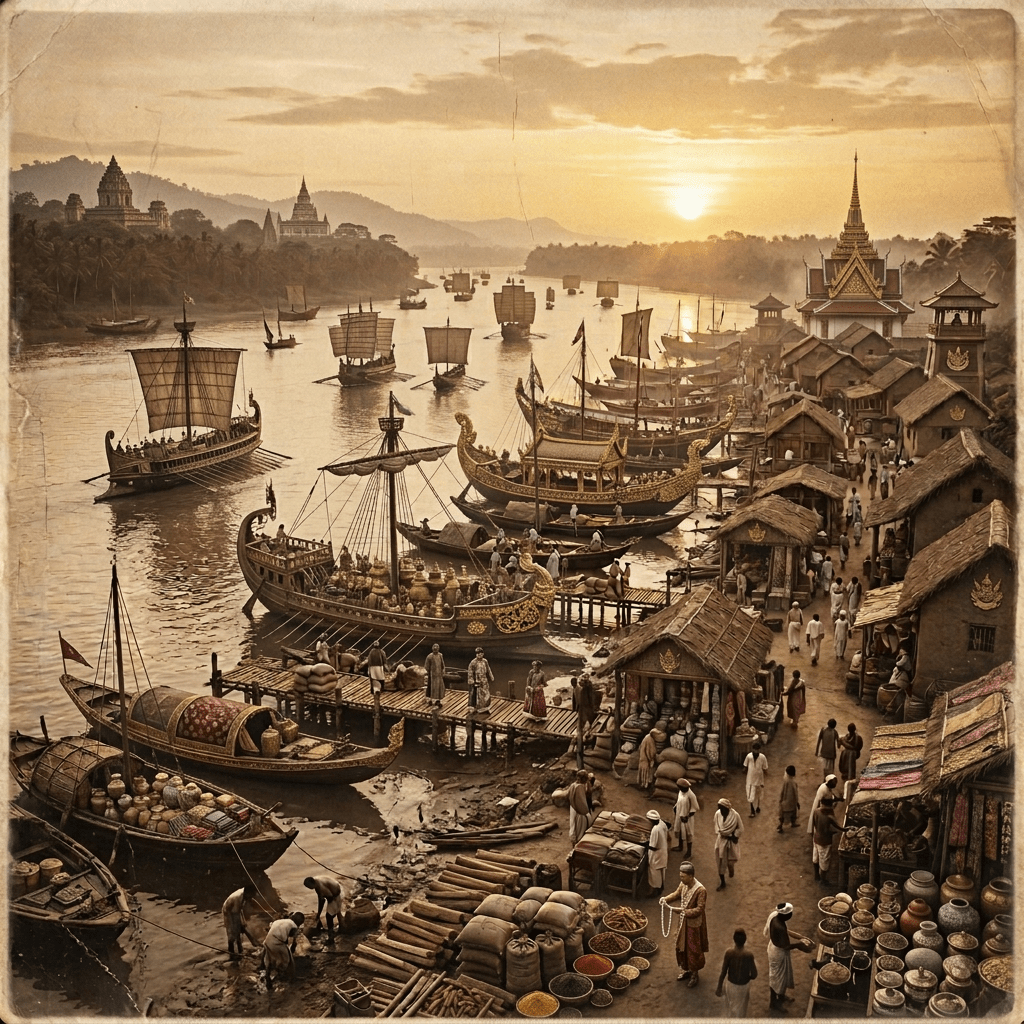
When Ancient Bengal Looked Out to the World: Tamralipta, the Forgotten Port
Voice 1: The question this piece opens with is a quiet but pointed one — how did ideas and goods cross oceans before maps and machines made it straightforward? And the answer it offers is a place most people have never heard of.
Voice 2: The post sets up that gap directly. Vani tells Megh: “Long before Kolkata, Chennai or Mumbai existed, Tamralipta was already connecting eastern India with the world. It remained an important port for several centuries under different kingdoms. Few ports enjoy such a long history.”
Voice 1: So the forgetting isn’t ancient — it’s recent. A port that outlasted multiple kingdoms somehow didn’t make it into the general story we tell about Indian trade.
Voice 2: And the trade itself was substantial. Ships leaving Tamralipta carried cotton textiles, silk, rice, spices, lac, ivory, beads, metalware, and carved conch-shell products. Returning vessels brought precious stones, metals, fine pottery, and luxury goods. It was a genuine exchange, not a one-way extraction.
Voice 1: Navigation without instruments is the part that stops you cold — they read the sun by day, stars by night, and treated the monsoon winds as a published timetable.
Voice 2: The post makes that point with some elegance. Vani says: “Today airlines publish flight schedules. In ancient times, nature published the sailing schedule.” Missing the right season could delay a voyage by months.
Voice 1: Which is why Faxian — the Chinese Buddhist monk who passed through Tamralipta around the fifth century CE — apparently waited there for months before a suitable ship and favourable winds arrived.
Voice 2: That detail matters because it shows Tamralipta wasn’t only a commercial node. Monks, scholars, pilgrims, and diplomats all moved through it. The post makes the point plainly: the port wasn’t simply moving goods, it was moving ideas. A single ship might carry spices, textiles, and a monk with palm-leaf manuscripts.
Voice 1: Buddhism travelled by sea. That’s not a metaphor — it’s logistics.
Voice 2: And the port’s end came not from conquest but from geography. Rivers shifted course, silt accumulated, and large ships found navigation increasingly difficult. As the post puts it: “Sometimes history is rewritten not by kings, but by rivers.”
Voice 1: The piece closes with a hint at what’s next — a banker whose name carried enough weight that emperors, nawabs, and foreign trading companies all sought his support. Those connections Tamralipta built had to be managed by someone.
Voice 2: The thread running through all of this is exchange — goods, yes, but also knowledge and trust, carried across water long before anyone had a word for it.
Voice 1: Next time, apparently, we meet the man who turned those connections into something even harder to sink than a port. Until then. Read more…

