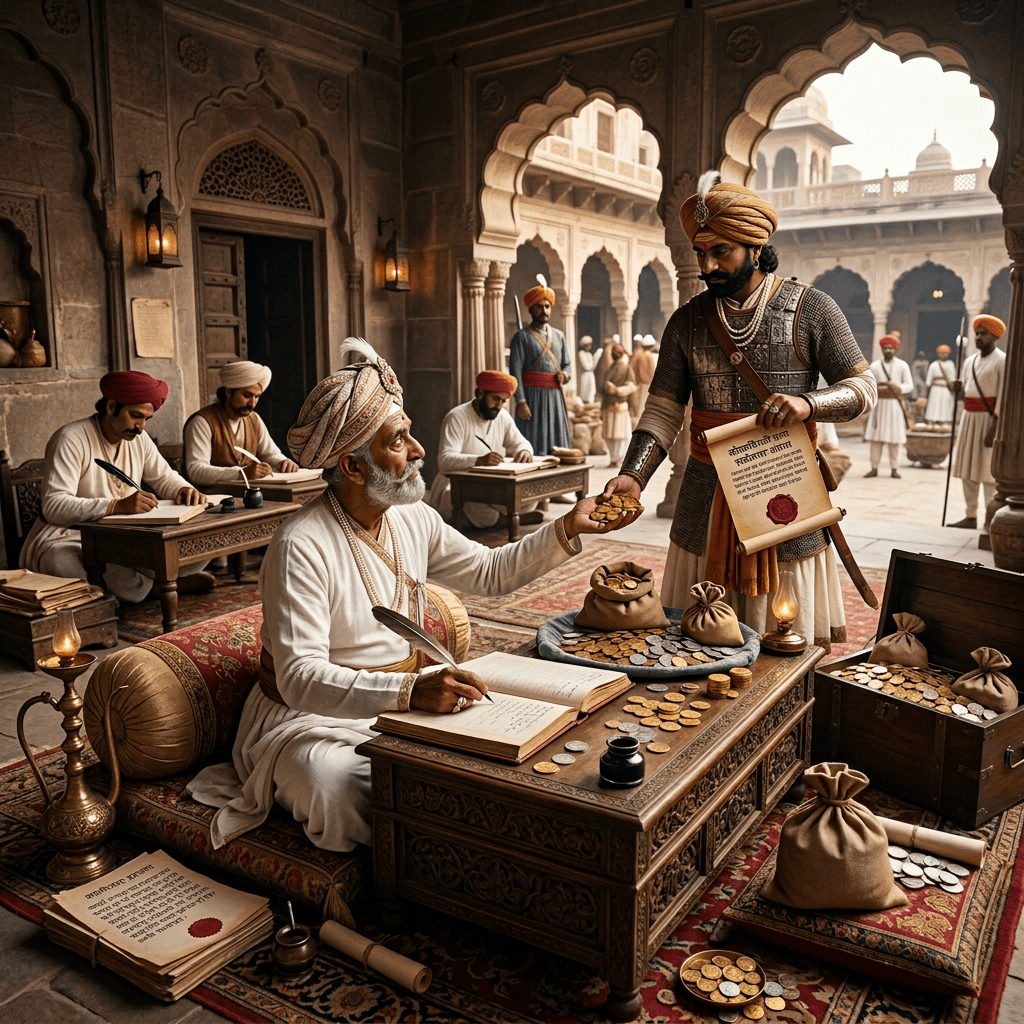
Voice 1: There is a particular kind of historical figure who shaped empires without ever commanding an army — and Kathakar has found one worth the detour.
Voice 2: This episode follows a single extended piece on Jagat Seth, the eighteenth-century banking house whose reputation for trust made them indispensable to merchants, nawabs, and European trading companies alike.
Voice 1: Let’s start with how a merchant family from Rajasthan became the financial backbone of Bengal.
—
The Banker Who Could Finance an Empire
Voice 2: The central question here is deceptively simple: when goods travelled by ship and caravan, how did enormous sums of money move safely across a subcontinent without anyone physically carrying chests of gold?
Voice 1: The post sets up that question through a dialogue between Vani and Megh, and Vani’s answer cuts straight to the point: “Not a fort. Not a palace. Not even a kingdom. A banking house.”
Voice 2: That framing matters. It positions Jagat Seth not as a curiosity of wealth but as an institutional achievement — a network of trust that made commerce possible at scale.
Voice 1: And the trust angle is what the post keeps returning to. It draws a clean distinction between being wealthy and being credible — a merchant could lose gold and earn it again, but a banker who lost trust lost everything.
Voice 2: The post traces the family’s origins to the Oswal Jain merchant communities of the Marwar region in present-day Rajasthan. Their commercial activities are believed to have first taken root in Patna before the family recognised Bengal’s growing importance and moved east.
Voice 1: Patna to Murshidabad is quite the career arc — though apparently Bengal’s silk, muslin, and saltpetre trade made it the obvious next stop.
Voice 2: The post describes Murshidabad at its peak as “one of the richest cities in Asia,” with the Bhagirathi River carrying boats loaded with goods while European trading companies established factories there. The family’s reputation grew alongside Bengal’s economy.
Voice 1: The name itself is worth pausing on — “Jagat Seth” was not a surname but an honorific, awarded by the Mughal emperor Muhammad Shah to Fateh Chand. In Persian, it translates roughly as “Banker to the World.”
Voice 2: The post is careful on the wealth claims, noting that historians resist dramatic superlatives. What it asserts with confidence is that the banking house ranked among the most influential financial institutions in eighteenth-century India, trusted by merchants, revenue officials, and nawabs alike.
Voice 1: And the mechanism behind all of it — how money actually moved without moving — is left as the next instalment’s territory: a financial instrument called the hundi.
Voice 2: Which means the real infrastructure story is still to come.
—
Voice 1: Reputation as infrastructure — it is a quieter kind of power than a cannon, but apparently it reaches further.
Voice 2: And the hundi question suggests the next piece will get into the mechanics of how that trust was actually operationalised across distance. Read more…

