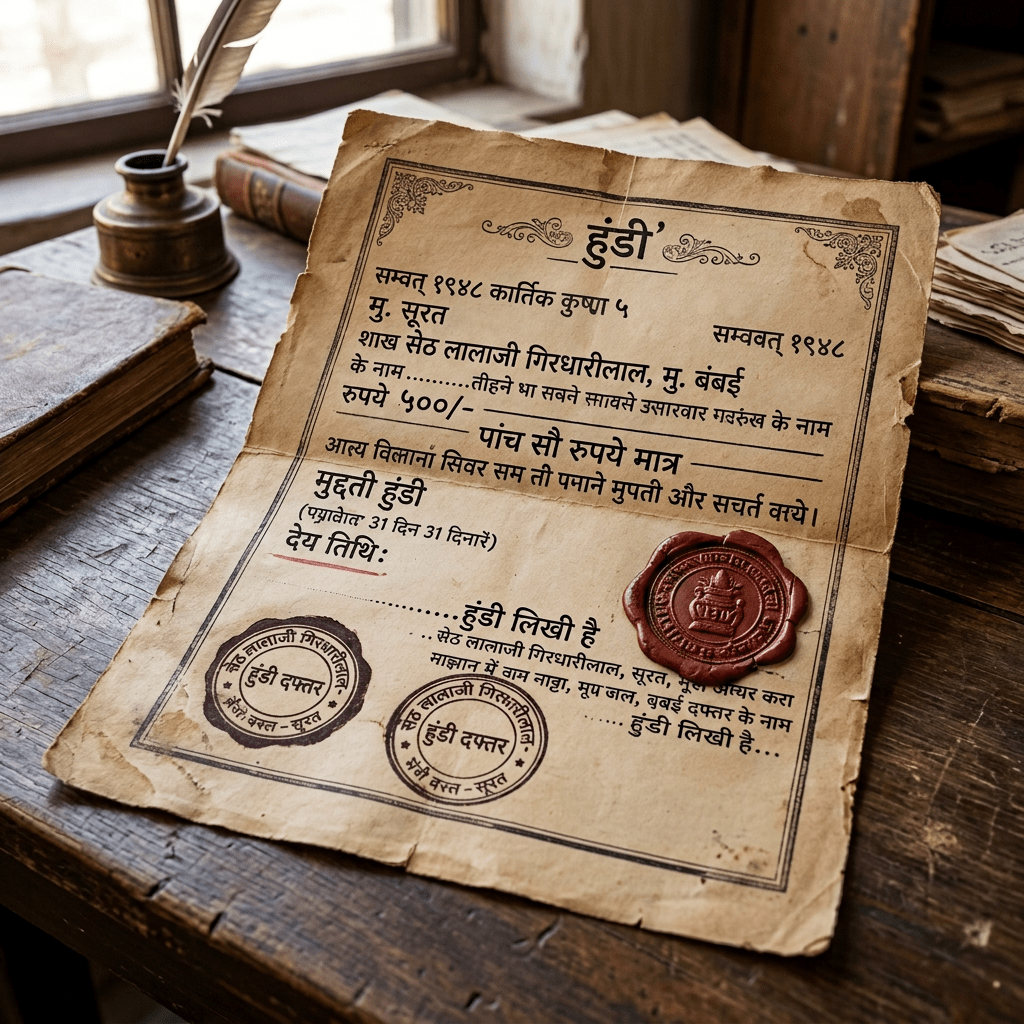
Audio 1: Before there were wire transfers, before there were banks on every corner, India had something older and arguably more elegant — a piece of paper that moved fortunes without moving a single coin.
Audio 2: This episode follows Kathakar into the world of the hundi, India’s pre-modern credit instrument, and what it reveals about trust, trade, and the infrastructure of commerce long before digital payments existed.
Audio 1: Let’s start with the paper itself — and the network it held together.
When Trust Travelled on Paper: India’s Invisible Banking Network
Audio 2: The question at the centre of this piece is deceptively simple: if you couldn’t safely carry silver across hundreds of kilometres, how did medieval Indian commerce actually move money?
Audio 1: And the answer, as the post sets it up through a conversation between Vani and Megh, is that merchants stopped moving money at all. Vani puts it plainly: “Instead of carrying wealth, merchants carried trust. A banker issued a hundi. Another banker, hundreds of kilometres away, honoured it. The paper travelled. The money did not.”
Audio 2: Which means the hundi wasn’t really a financial instrument in the narrow sense — it was a claim on a relationship. The post makes this explicit: the value didn’t lie in the paper itself, but in the reputation of the banking house behind it.
Audio 1: That’s a distinction worth sitting with. One dishonoured hundi, the post notes, could damage relationships built over generations — which is why names like Jagat Seth carried the weight they did. The currency wasn’t silver. It was decades of integrity.
Audio 2: The post also walks through how the system actually worked in practice. A merchant who had sold silk in Murshidabad could visit a trusted banking house, receive a hundi, travel to Surat carrying only that document, and collect payment there — the two banking houses settling their accounts separately through their own commercial network.
Audio 1: Contactless payments, twelfth-century edition.
Audio 2: And the system was more differentiated than that framing suggests. A Darshani Hundi was payable immediately on presentation. A Muddati Hundi deferred payment to an agreed date. A Jokhmi Hundi was tied to risky ventures — particularly maritime trade — where payment depended on goods arriving safely. Specialised instruments for specialised risks.
Audio 1: What strikes me is that none of this required a central bank or a regulatory framework. It ran entirely on network trust — which, the post argues, is precisely what made it both resilient and transferable across the subcontinent.
Audio 2: The post closes on that note: long before digital payments connected India through technology, trust had already connected its markets.
Audio 1: The hundi is a reminder that the infrastructure of commerce is almost never the thing you can see — it’s the reputation underneath it.
Audio 2: Next time, more from that thread — the institutions and ideas that kept trade moving when the systems were invisible. Read more…

