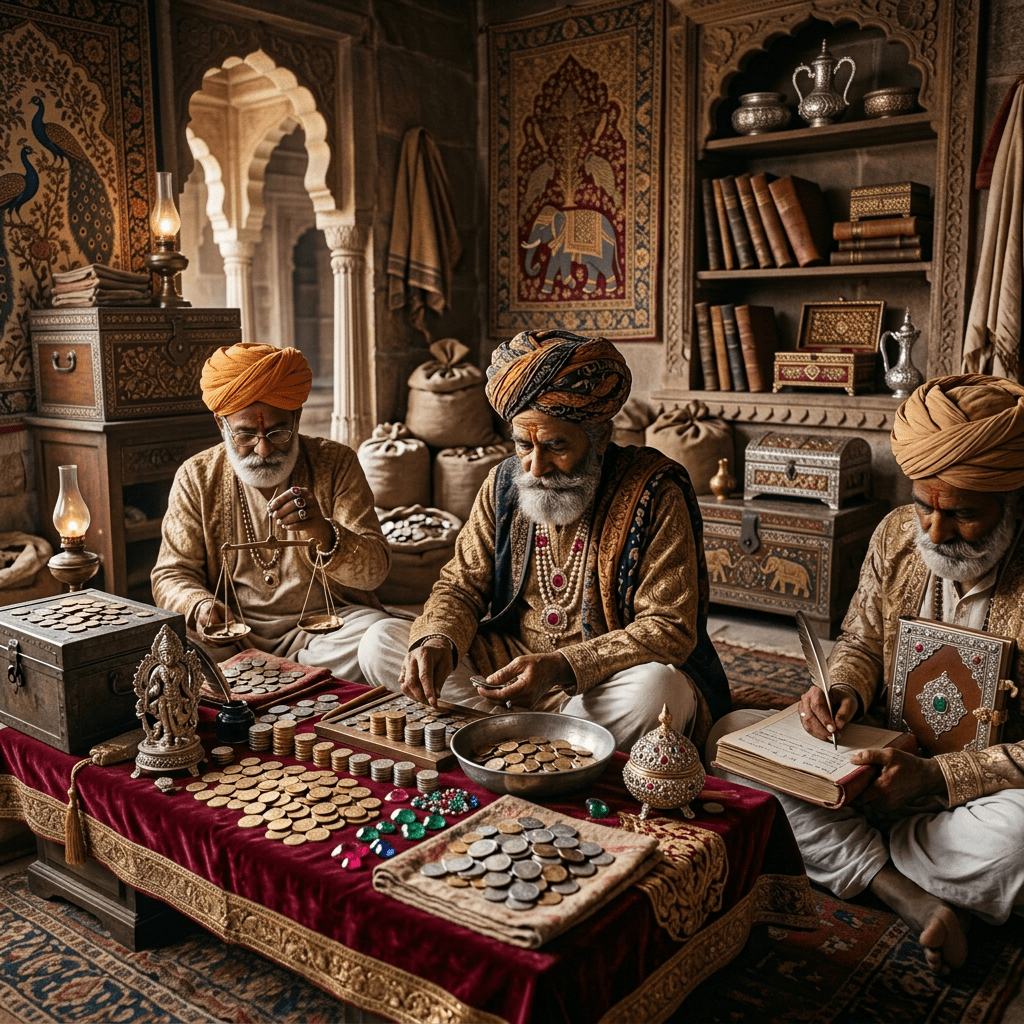
(Megh comes to Vani’s place in the weekend afternoon. There he reminds Vani’s promise on the story of Jagat Seth.)
Megh: Vani, last time we spoke about Tamralipta. You said that once we understood how goods travelled across rivers and seas, we should also understand how money travelled.
Vani: I remember.
Megh: I’ve been thinking about it ever since. Ships could carry silk, spices and precious stones. Caravans could cross mountains and deserts. But how did merchants carry enormous wealth safely across such long distances? Surely they couldn’t keep transporting chests full of gold and silver.
Vani: That is an excellent question, Megh. In fact, the answer lies at the heart of one of India’s greatest yet least remembered institutions.
Megh: An institution?
Vani: Yes. Not a fort. Not a palace. Not even a kingdom. A banking house!!
Megh: A banking house in eighteenth-century India?
Vani: Long before modern banks, cheque books or electronic transfers, India had sophisticated systems of finance. Merchants, rulers and traders relied on networks of trust that stretched across hundreds, sometimes thousands, of kilometres. Among those networks, one name became synonymous with wealth, credit and confidence. Jagat Seth.
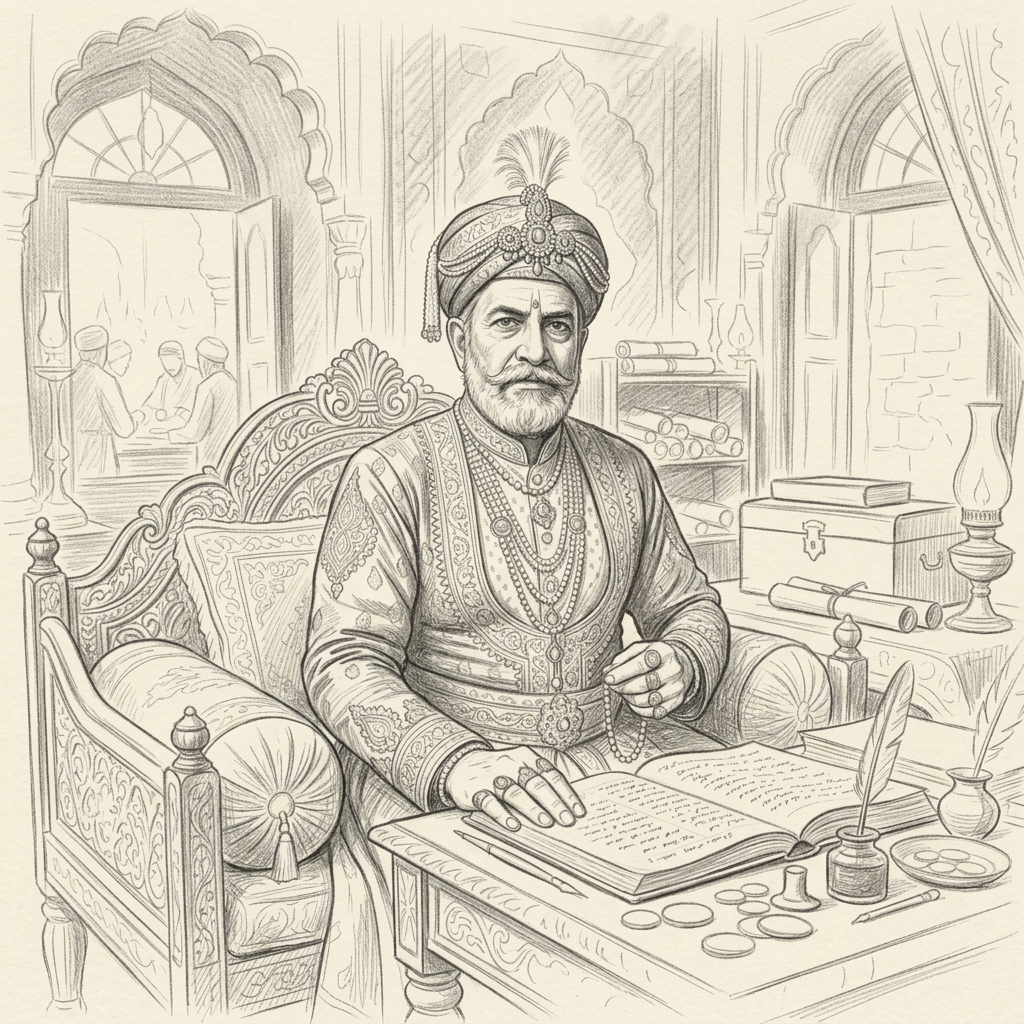
Megh: I’ve heard that name only in connection with the Battle of Plassey.
Vani: And that is perhaps why most people never discover the real story. History often remembers Jagat Seth because of politics. But long before political intrigue entered the picture, the family had already become one of the most influential banking houses in the Indian subcontinent. Their story is not merely about wealth. It is about trust.
Megh: Who exactly were they?
Vani: To answer that, we must first travel to Murshidabad.
Today it is a quiet town in West Bengal. Three centuries ago, however, it was one of the richest cities in Asia. The Bhagirathi River flowed gently beside it, carrying boats loaded with silk, muslin, saltpetre, sugar, rice and countless other goods. Merchants from different parts of India met here, while European trading companies established factories to participate in Bengal’s flourishing commerce.
The city was not only the capital of the Nawabs of Bengal. It was also a great commercial centre where trade, administration and finance worked together.
Megh: Was Bengal really that prosperous?
Vani: Very much so.
During the first half of the eighteenth century, Bengal was widely regarded as one of the wealthiest regions of the Mughal Empire. Its fertile lands produced abundant agricultural output. Its artisans were renowned for weaving some of the finest textiles in the world. Bengal silk and muslin found markets across Asia and Europe, while products such as saltpetre were in great demand internationally.
Prosperity, however, creates another challenge. When commerce grows, money must move just as efficiently as goods. That is where bankers became indispensable.
Megh: So merchants trusted them with their wealth?
Vani: Much more than that. They trusted them with their reputation.
A respected banking house could arrange payments between distant cities, provide credit to merchants, finance governments and facilitate trade without physically transporting large quantities of precious metal. In many ways, they became the invisible foundation upon which commerce rested.
Megh: And among all these banking houses, Jagat Seth stood apart?
Vani: Yes. The family did not become famous overnight. Their rise was gradual, built over decades through financial expertise, commercial relationships and, above all, an unwavering reputation for honouring their commitments. Their influence eventually became so great that rulers sought their financial support, merchants relied on their credit and even European trading companies recognised their importance.
But before they became known as Jagat Seth, they were simply a family of merchants who understood a timeless truth. Wealth may attract attention. Trust earns influence. And sometimes, influence can shape history more quietly than an army ever could.
Megh: Then perhaps we should begin not with the title ‘Jagat Seth’, but with the family itself. How did an ordinary merchant family become the bankers of Bengal?
Vani: That is exactly where our story begins.
Megh: So, where does the story really begin, Vani?
Vani: Surprisingly, not in Murshidabad. It begins much farther west, in the arid lands of present-day Rajasthan.
Megh: Rajasthan?
Vani: Yes! For centuries, Rajasthan produced not only brave warriors but also remarkable merchant communities. Living in a region where agriculture alone could not sustain prosperity, many families mastered trade, finance and long-distance commerce. They travelled across the subcontinent, carrying with them not only goods but also business relationships built on trust. Among these communities were the Oswal Jains, many of whom became distinguished merchants and bankers.
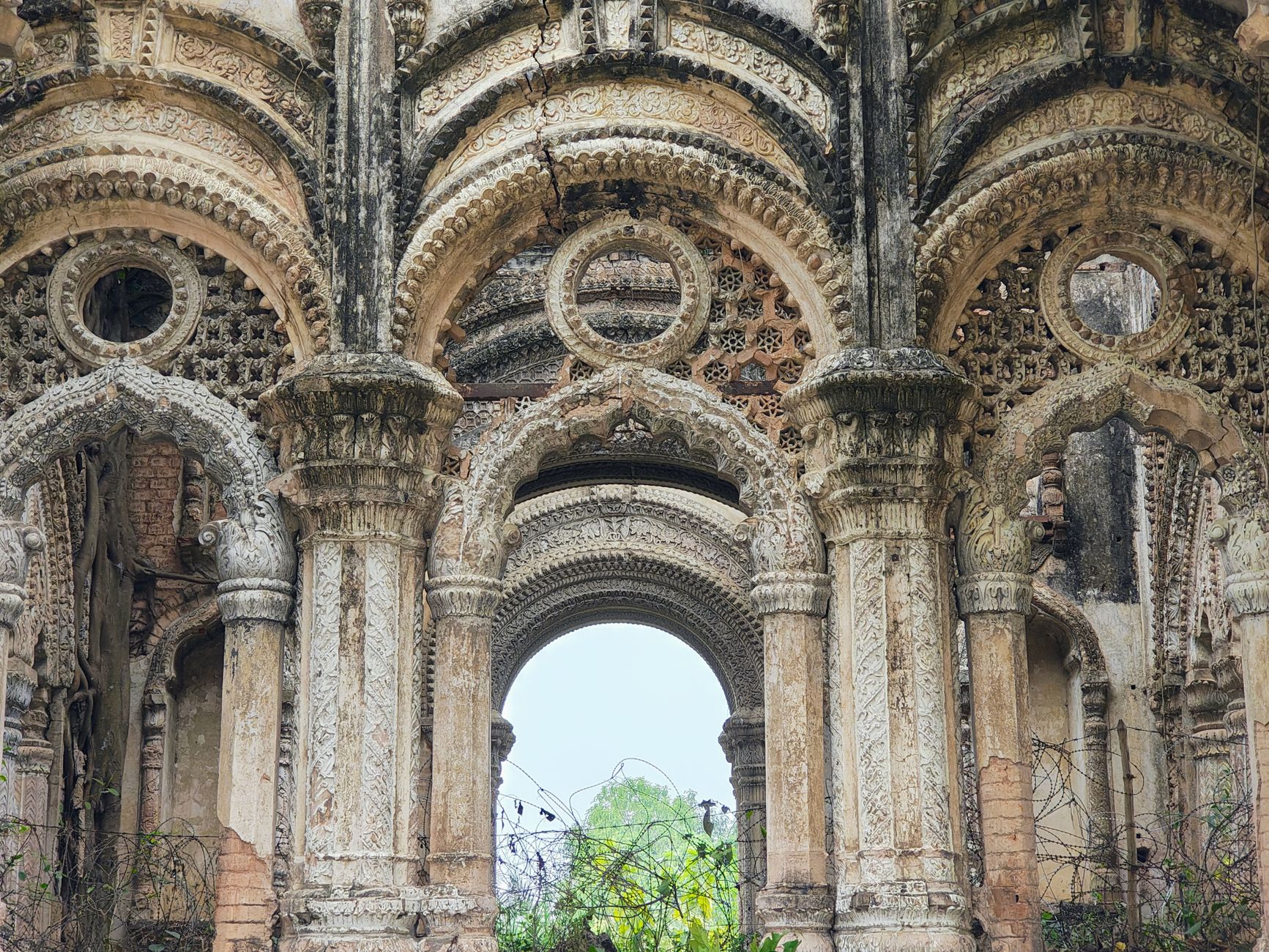
Megh: Was the Jagat Seth family one of them?
Vani: According to most historical accounts, yes.
The family traced its roots to the Oswal Jain community of the Marwar region. Like many merchant families of the time, they gradually expanded eastwards in search of new commercial opportunities.
Megh: Why eastwards?
Vani: Because eastern India was prospering. By the late seventeenth century, Bengal and Bihar had become among the most productive regions of the Mughal Empire. Agriculture flourished, textiles were exported across the world, and trade routes connected the region to ports on the Bay of Bengal as well as markets in North India. Where commerce grows, finance follows.
Megh: So the family first reached Bengal?
Vani: Not immediately. Many historians believe their commercial activities first became established in Patna.
Megh: Patna was important even then?
Vani: Extremely important. Today we know Patna as the capital of Bihar. Three hundred years ago, it was one of the great commercial cities of northern India. Saltpetre, opium, fine textiles and many other commodities passed through its markets. Merchants from different regions met there, and banking houses found abundant opportunities to support this growing trade.
Megh: Did the family become famous there?
Vani: They became respected. And that distinction is important. Reputation in banking is rarely built overnight. Unlike a successful trader who may profit from a single voyage, a banker earns confidence only by honouring countless promises over many years.
Every loan repaid. Every payment delivered. Every commitment fulfilled. Trust accumulated slowly!!
Megh: That sounds remarkably modern.
Vani: Human nature has not changed very much. Even today, people choose a financial institution because they believe it will safeguard their money and honour its obligations. Three centuries ago, the principle was exactly the same. Only the technology was different.
Megh: Then how did the family reach Murshidabad?
Vani: As Bengal’s political and commercial importance increased, so did the need for experienced financiers. During the early eighteenth century, Murshid Quli Khan reorganised Bengal’s administration and shifted the provincial capital from Dhaka to the city that would later bear his name-Murshidabad. The new capital soon attracted merchants, administrators, artisans and bankers from different parts of India. The family that would later become known as Jagat Seth was among those who recognised the opportunity.
Megh: Was this when they became the Nawab’s bankers?
Vani: Gradually. Great institutions are seldom created in a single moment. The family’s growing reputation for financial reliability enabled them to work with merchants, revenue officials and eventually the provincial administration itself. Their banking house expanded as Bengal’s economy expanded.
Megh: I’ve always wondered about the name. Was “Jagat Seth” the family’s surname?
Vani: No!! That is a common misunderstanding. “Jagat Seth” was an honorific title. In Persian, Jagat means “the world” and Seth or Sheth refers to a respected merchant or banker. The title may be understood as something close to “Banker of the World” or “Banker to the World.”
Most historians agree that the title was bestowed upon Fateh Chand by the Mughal emperor Muhammad Shah during the early eighteenth century, recognising the extraordinary stature of the banking house. Over time, however, the title became so closely associated with the family that people began referring to the entire banking house simply as “Jagat Seth.”
Megh: So one title became the identity of an entire institution.
Vani: Exactly!! Sometimes history remembers institutions through a single name. Just as we speak of the East India Company or the Rothschilds, people across India came to recognise the name Jagat Seth as a symbol of financial credibility.
Megh: They must have been extraordinarily wealthy.
Vani: They certainly possessed immense wealth. But historians are careful about making dramatic claims such as “the richest family in the world.”
Such statements are difficult to prove. What we can say with confidence is this: The Jagat Seth banking house ranked among the most influential financial institutions in eighteenth-century India. Its reach extended across major commercial centres, and its opinion carried weight with merchants and rulers alike.
Megh: Wealth can be counted. Influence seems much harder to measure.
Vani: Precisely. And that is why the story of Jagat Seth is not really about money. It is about confidence. A merchant could lose gold and earn it again. But if a banker lost trust, everything else disappeared with it. In the world of commerce, reputation was the most valuable asset anyone could possess.
Megh: But there is still one question that puzzles me. How did a banking house actually move such enormous sums across India without transporting chests full of coins?
Vani: Ah, Megh!! The answer lies in a simple piece of paper called a hundi. This can be discussed further in next Friday dinner at your place (smiling gently).
Megh: (While smiling) Why not!! You are also behaving like a trader now!!

