Voice 1: Kathakar writes stories where the snacks do as much narrative heavy lifting as the characters — and honestly, that’s a sound editorial philosophy.
Voice 2: This episode follows one of those stories: a Vijaya Dashami visit, a Rajasthani puppet, and a sweet that carries several centuries of culinary history. Let’s start with the confection at the centre of it all.
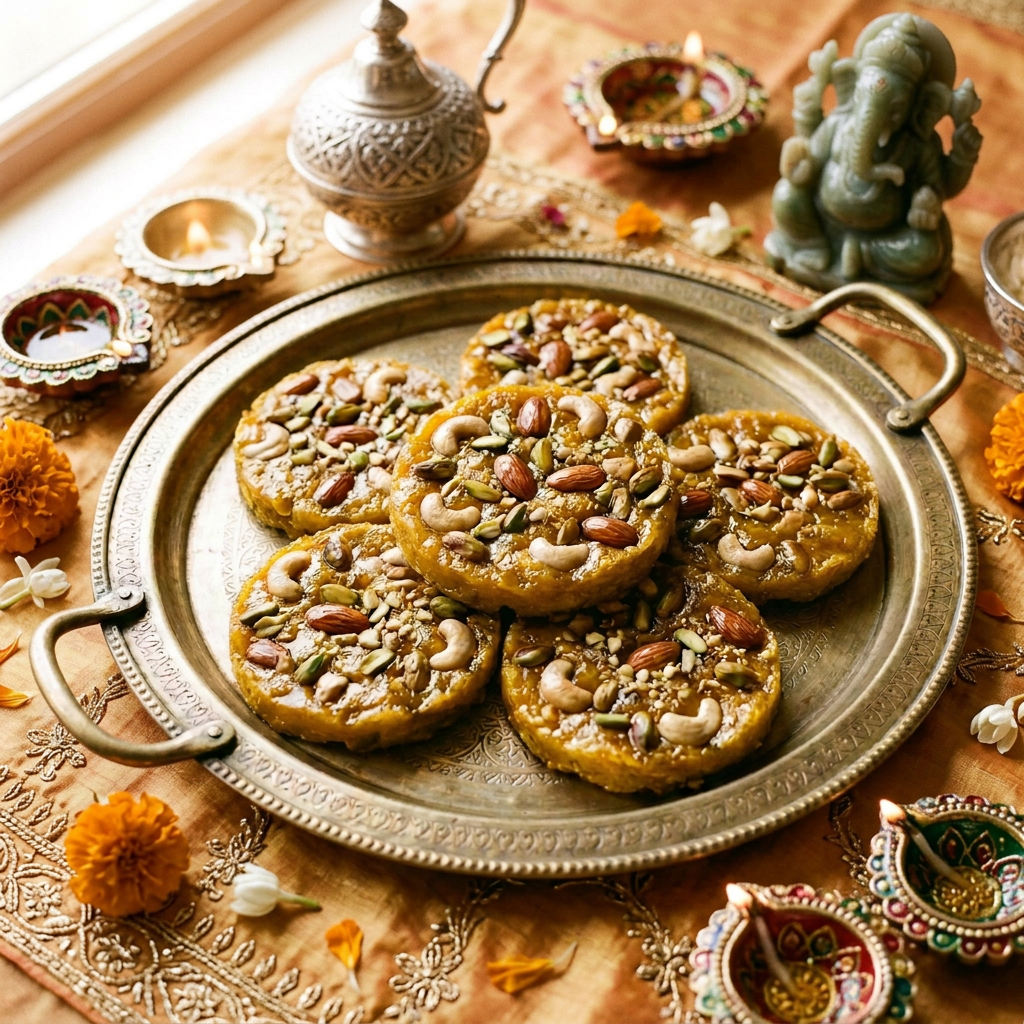
Confection: Sohan Halwa
Voice 1: The setup here is deceptively simple — a guest notices a sweet, asks what it is, and suddenly the room becomes a small seminar on Mughal-era culinary history.
Voice 2: Vani traces it back precisely: “The origins of Sohan Halwa date back to the Mughal era, during the reign of the great Emperor Akbar. It is said that the emperor’s royal kitchen was graced by a skilled chef named Sohan, whose culinary prowess knew no bounds.”
Voice 1: So the sweet is literally named after its inventor — a royal kitchen chef who apparently cracked the milk, sugar, ghee, and nuts combination well enough that three centuries later people are still making it.
Voice 2: And it travelled. Vani describes the spread from Delhi’s streets to Lahore’s bazaars, the aroma drawing in passers-by. The recipe didn’t stay in the palace — it moved with the empire and then outlasted it.
Voice 1: Megh asks the obvious question: is the same recipe still running after three hundred years? Which is a fair thing to wonder with your mouth full.
Voice 2: Vani points to Amritsar as a living answer — local artisans still handcrafting it, saffron-infused, dressed with almonds and pistachios, the traditional base adapted with regional character. The recipe persists, but it absorbs its geography.
Voice 1: Megh’s conclusion is that the real failure is marketing. “I think we lag on the advertisement part. Otherwise, this also can be tagged as finger lickingly delicious.” He’s not wrong, though it’s doing fine without the campaign.
Voice 2: Vani’s mother gets the last word, and it reframes everything: “Sohan Halwa has remained more than just a dessert; it is a symbol of celebration, unity, and the enduring sweetness of tradition, forever etched within the cultural tapestry of the Indian subcontinent.”
Voice 1: Which is also, quietly, what the whole scene is doing — the puppet, the sweet, the mother’s earlier nudge about knowing your cultural heritage. The snack is the argument.
Voice 2: Exactly — the confection is the thread connecting the Vijaya Dashami visit to something much older.
Voice 1: Heritage carried in a recipe, history explained over a plate — it’s a tidy way to make the past feel edible.
Voice 2: Next time, more from Kathakar’s world — more stories where the everyday holds something worth examining closely. Read more…
 Kathakar